Subscribe to our newsletter to get the latest news on our programs, initiatives, and events!

5.15.25 – Understanding Cervical Cancer is a Matter of Protecting our Sisterhood, Our Families and Our Future

A Thought Piece by: Maleina Aguinaldo, Biology Student, University of San Francisco and LEAD Filipino
I became involved with LEAD Filipino’s Health Equity Team after experiencing a deep personal loss: the passing of my auntie Arlene to cancer, a disease that feels all too familiar in many Filipina/x/o American families – and, Americans generally nowadays. Recently, our LEAD Filipino community mourned the passing of Carina Mae Owens, a beloved sister, activist, and friend, who transitioned after a brave battle with a rare and incurable form of cancer. Carina was the type of person whose energy changed the temperature of a room and whose dedication to youth, women, and culture has forever left an imprint on our community.
Though my auntie Arlene and Carina didn’t face cervical cancer, their stories and battles remind us that cancer steals too many of our loved ones. Their stories demonstrate the urgency to protect the health of our sisters, mothers, cousins, aunties, and friends. In our culture and community, sisterhood is sacred. There’s an indescribable feeling of empowerment that comes from being surrounded by a room full of powerful women- the same feeling I experience every year at our annual Fly Pinays Women’s Leadership Summit, which continues to be a true testament of that shared power. We do not exist as individuals alone; we are daughters of generations of strong women who have cared and leaned on each other, and continue to survive because of it.
This is why cervical cancer prevention is not just a medical issue for us, it is a matter of protecting our sisterhood, our families, and our future.
Cervical cancer is a type of cancer that begins in the cervix which is the lower part of the uterus. The cervix is what connects the uterus to the vagina. It usually develops slowly over time and can be prevented through regular medical screenings and vaccinations (American Cancer Society, 2024). Cervical cancer is primarily caused by ongoing infection with high-risk types of human papillomavirus (HPV), which is a common sexually transmitted infection. Approximately 99% of all cervical cancers are linked to HPV, specifically the high-risk strains HPV-16 and HPV-18, as confirmed by Walboomers et al. (1999). While the immune system naturally clears many HPV infections, a persistent infection of these strains can lead cervical cells to become cancerous. This is especially concerning for Filipina women, as access to early detection remains limited in many communities. As Christie-de Jong and Riley (2021) report, “Cervical cancer tends to be diagnosed at a late stage amongst Filipino women resulting in proportionally high mortality rates” (Christie-de Jong & Reilly, 2021, p. 18).
Many Filipina/x/o Americans face barriers that make it difficult to get the screenings and education needed to stay healthy and aware of cancer prevention practices. These barriers include cultural stigmas around women’s health, fear of judgment, lack of culturally responsive healthcare providers, language barriers, and healthcare affordability. Cultural barriers such as embarrassment, modesty, the value of virginity, and the perception that cervical screening is sexually suggestive have been shown to discourage many Filipina women from participating in cervical cancer screening (McBride et al., 1998; Kagawa-Singer & Pourat, 2000; Holroyd et al., 2003; Chen et al., 2004; Gor et al., 2011). Additionally, “Filipinas were found to believe that health messages are most effectively conveyed by someone from their own culture to understand their cultural particularities and to build trust” (Fu et al., 2003; Aitaoto et al., 2009).
We can transform these uncomfortable conversations into affirming ones, because they are not only necessary, but lifesaving. As Health Equity organizers, we offer culturally responsive education by meeting our community at festivals, churches, schools, and in the spaces they already congregate to bring these important conversations and resources to them.
In 2020, LEAD Filipino, in partnership with Stanford Cancer Institute, launched a community action study to better understand cancer awareness, behaviors, and barriers among Filipina/x/o Americans in Santa Clara County. Our findings confirmed what we already knew: our kababayan are falling through the cracks when it comes to cancer prevention, early detection, and care. Since then, with the help of Dr. Elwyn Cabebe and Dr. Rachel Mesia, we have completed the study and we are excited to share what we have learned!
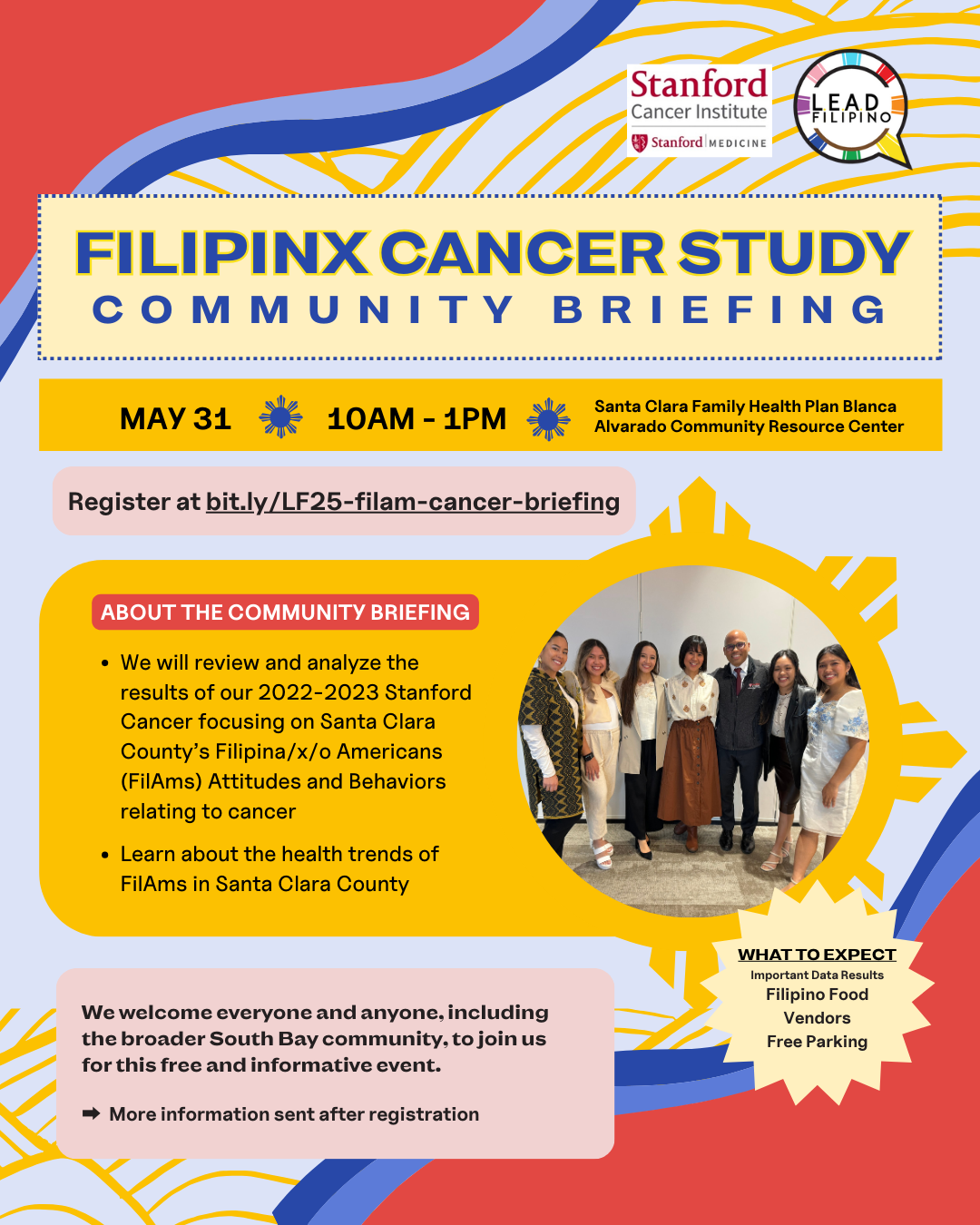
Join us for our Filipinx Cancer Action Study Community Briefing in person on May 31st from 10am – 1pm PST as we break down the data. This research is deeply personal and rooted in passion; it reflects the lived experiences of our community and the health disparities that we can no longer afford to overlook. It is our collective responsibility to demand better research, representation, and resources for our people, and our study has been a step in the right direction.
Taking care of our health is an act of love for our families and our community. We owe it to the sisters who came before us and the ones who will come after us. Our work is a reflection of our values: bayanihan (community), kapwa (shared identity), and pagmamahal (love) through sisterhood, education, and action. We are not just fighting disease, we are protecting the stories, the joy, and the futures of the people we love the most. When one of us is informed, we share that knowledge across generations.
Cervical Cancer Detection and Factors
The NIH outlines several factors that increase the risk of developing cervical cancer.
This includes:
- having a weakened immune system
- having multiple sexual partners or early sexual activity especially without the use of condoms
- Smoking including breathing in secondhand smoke
- long-term use of oral contraceptives
- having given birth to three or more children
- obesity
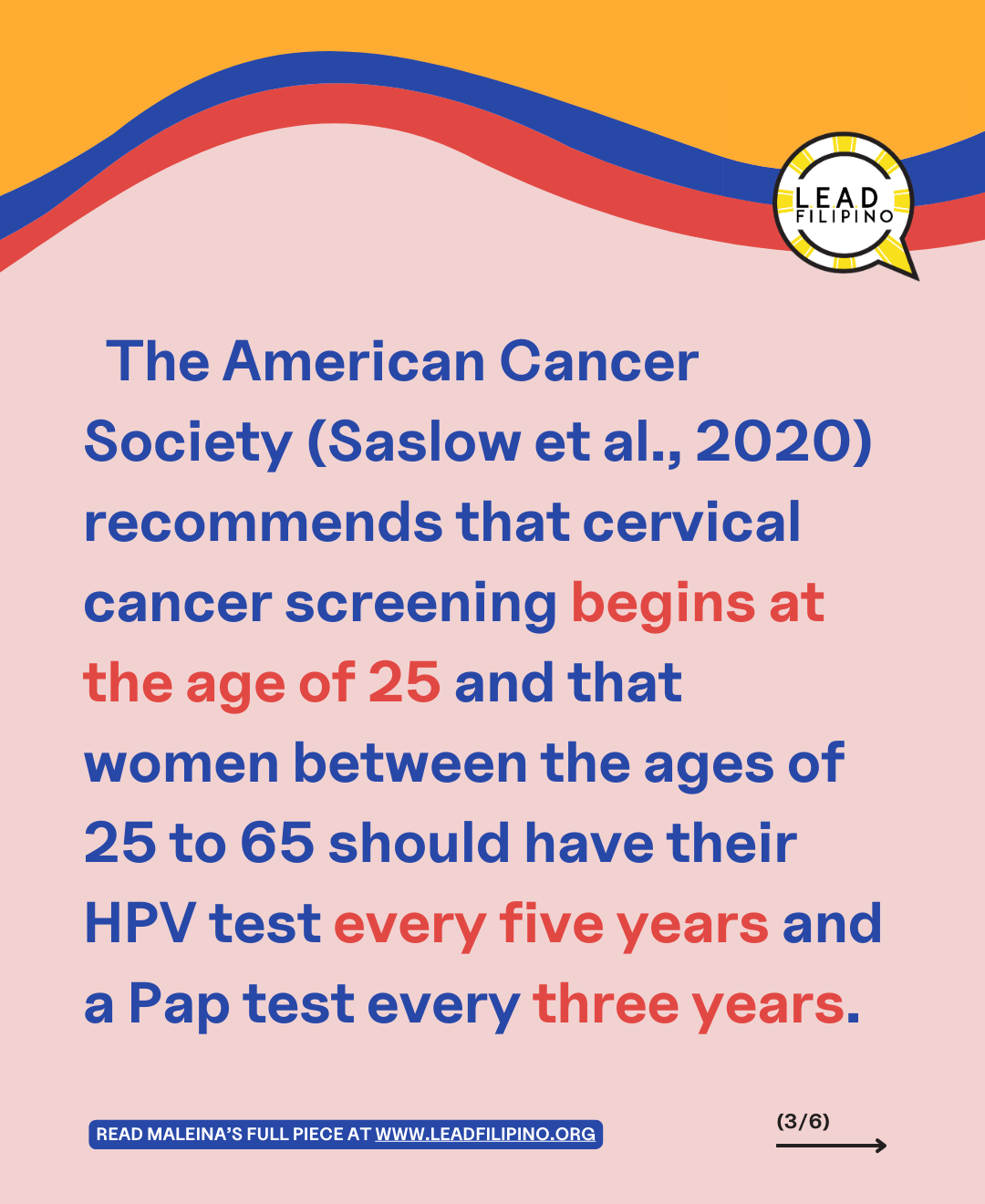
Screening tools such as the Pap smear and HPV tests play vital roles in early detection. The Pap test detects abnormal cervical cells before they become cancerous, while the HPV tests spot the presence of high-risk HPV types.
Prevention and Treatment
It is also found that prevention strategies are very effective:
- The HPV vaccine is safe and over 90% effective in preventing infections from the most dangerous HPV types (Paavonen et al., 2007)
- The Centers for Disease Control and Prevention (CDC, 2023) recommend the HPV vaccination starting at ages 11 to 12, with a catch-up vaccination available through age 26. There is also a selective vaccination available for adults up to age 45 after consulting with a healthcare provider. Additionally, other important preventative measures include regular cervical cancer screenings, practicing safe, protected sex, and avoiding tobacco use.
- Treatment for cervical cancer depends on the stage of diagnosis and may include surgical interventions such as hysterectomy, which is the removal of the cervix or uterus, radiation therapy, chemotherapy, targeted therapy, and immunotherapy to very advanced metastatic cases (Tewari et al., 2014)
Whether it is by getting screened, starting conversations with our loved ones, or showing up for community events like our briefing on May 31st, each of us has a role to play. You can register to reserve a spot at our cancer briefing here: Eventbrite Filipinx Stanford Cancer Study Community Briefing. For more updates and details about upcoming events or initiatives, you can visit our LEAD Filipino website, join our mailing list, or follow us on instagram @leadfilipino.
🔔Join us on May 31st! Register for our Filipinx Cancer Study Community Briefing here!
Sources
American Cancer Society. (2024). Cervical Cancer Facts.
Walboomers, J. M. M., et al. (1999). Human papillomavirus is a necessary cause of invasive cervical cancer worldwide. Journal of Pathology, 189(1), 12–19.
National Cancer Institute. (2024, August 15). Cervical cancer causes, risk factors, and prevention. U.S. Department of Health and Human Services. https://www.cancer.gov/types/cervical/causes-risk-prevention
Saslow, D., et al. (2020). CA: A Cancer Journal for Clinicians, 70(5), 321–346.
Paavonen, J., et al. (2007). Lancet, 369(9580), 2161–2170.
Centers for Disease Control and Prevention. (2023). HPV Vaccination Recommendations. Retrieved from cdc.gov
Tewari, K. S., et al. (2014). NEJM, 370(8), 734–743.
Christie-de Jong F, Reilly S. Barriers and facilitators to cervical screening for Filipino women – a narrative literature review. International Journal of Migration, Health and Social Care. 2020;17(1):16-34.