Subscribe to our newsletter to get the latest news on our programs, initiatives, and events!

8.9.24 – Oh My Gulay! Heart Disease in the Filipina/x/o Culture

In 2022, we launched our Holistic Health Series in partnership with Asian Americans for Community Involvement, YWCA and numerous nonprofit organizations. Our Series integrates direct outreach with culturally responsive health education workshops, resources and training for the Filipina/x/o American community across Santa Clara County. These efforts are driven by our team of public health and nursing students and professionals, known as our Health Equity Team. The following is an educational piece composed by Jennifer Cayanan, our Health Equity Director.
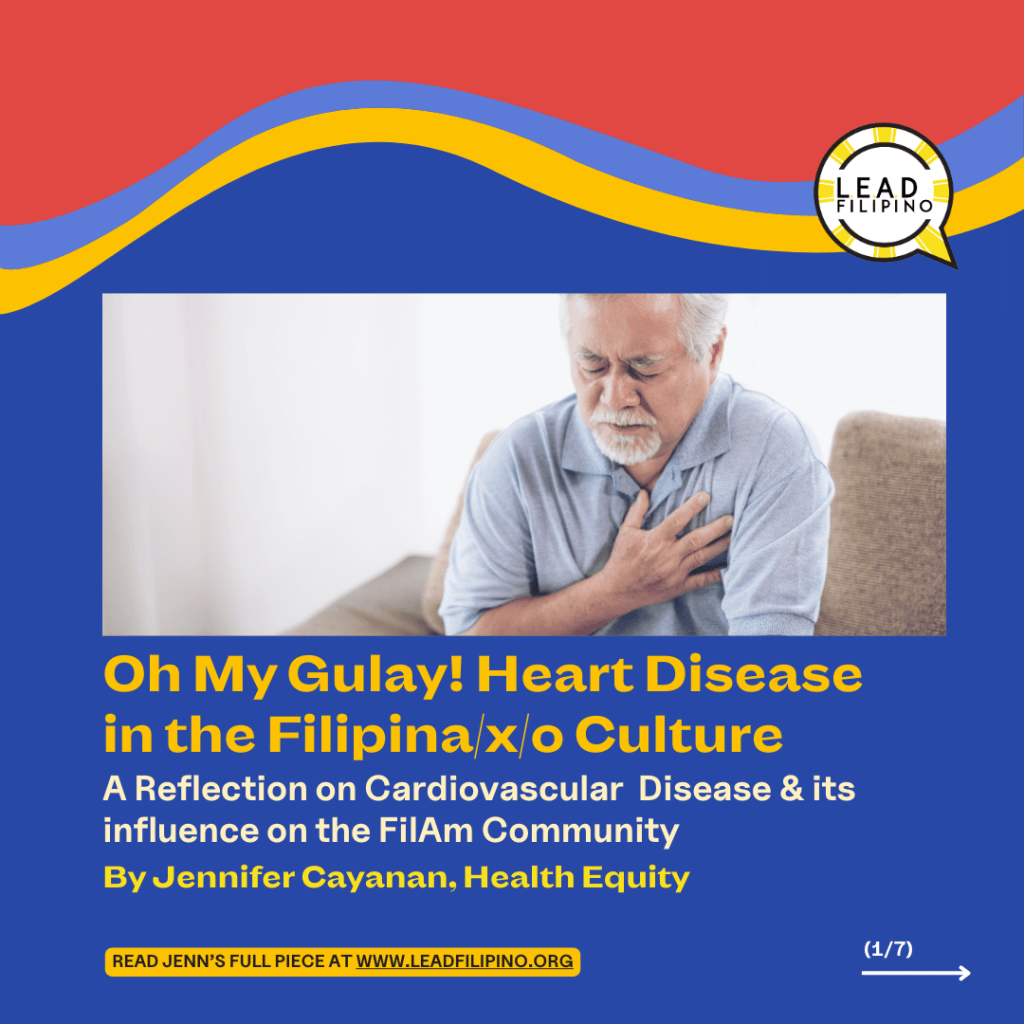


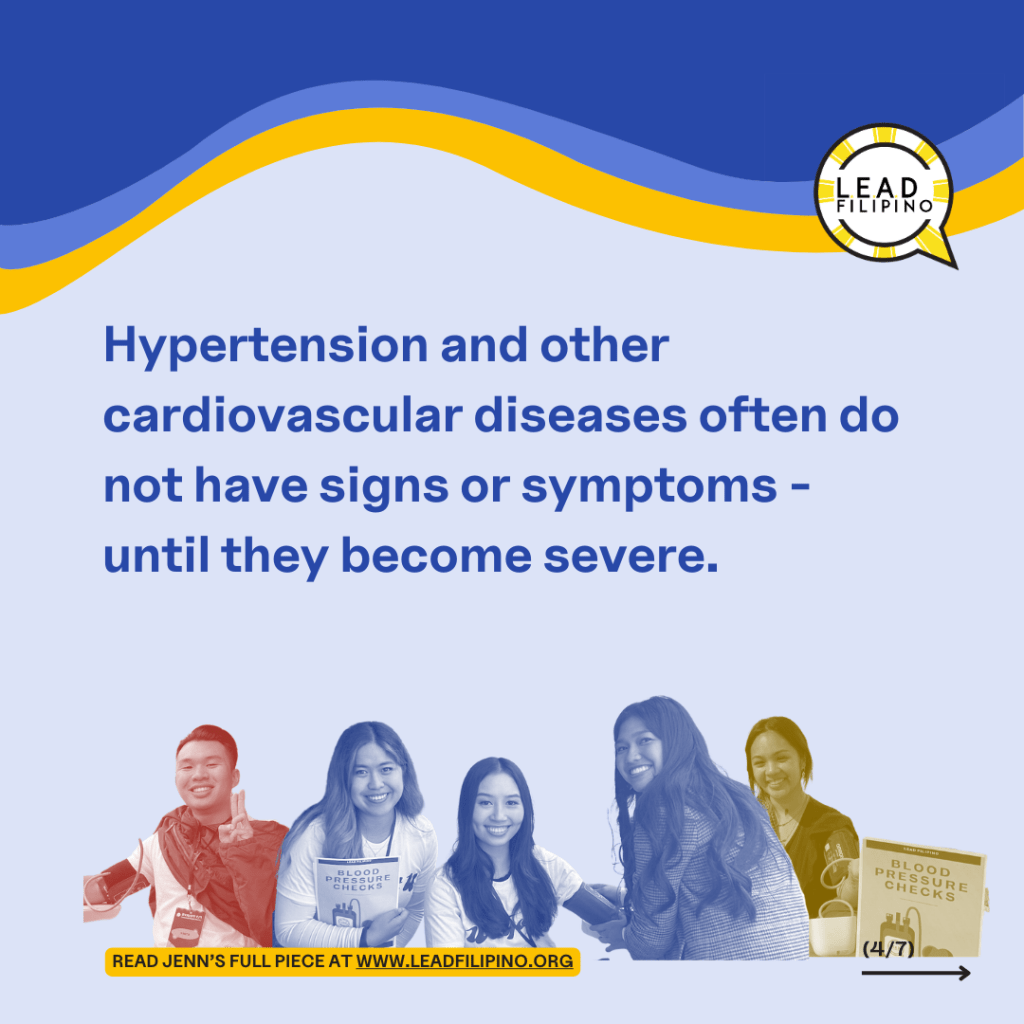

What if I told you that you were diagnosed with a disease that could kill you, but it was a silent killer? Would you be worried that one day this silent killer will kill you, or would you live and go about your day as if you never knew? It’s a silent killer, so how would you know? That is what it is like living with hypertension for many Filipina/x/o Americans (FilAms). Hypertension and other cardiovascular diseases oftentimes do not have signs or symptoms until they become severe.
How many of you know someone who unfortunately passed away from a heart-related disease? Cardiovascular disease disproportionately affects the Filipina/x/o American community. Cardiovascular disease is the number one killer among Filipina/x/o Americans (Sales, Lin, & Palaniappan, 2020). Filipina/x/o Americans had the lowest rate of blood pressure control nationally (Ma et al., 2018), and 33% of Filipina/x/o Americans were diagnosed with hypertension in Santa Clara County (Santa Clara County Public Health Department, 2017) where LEAD Filipino predominately serves.
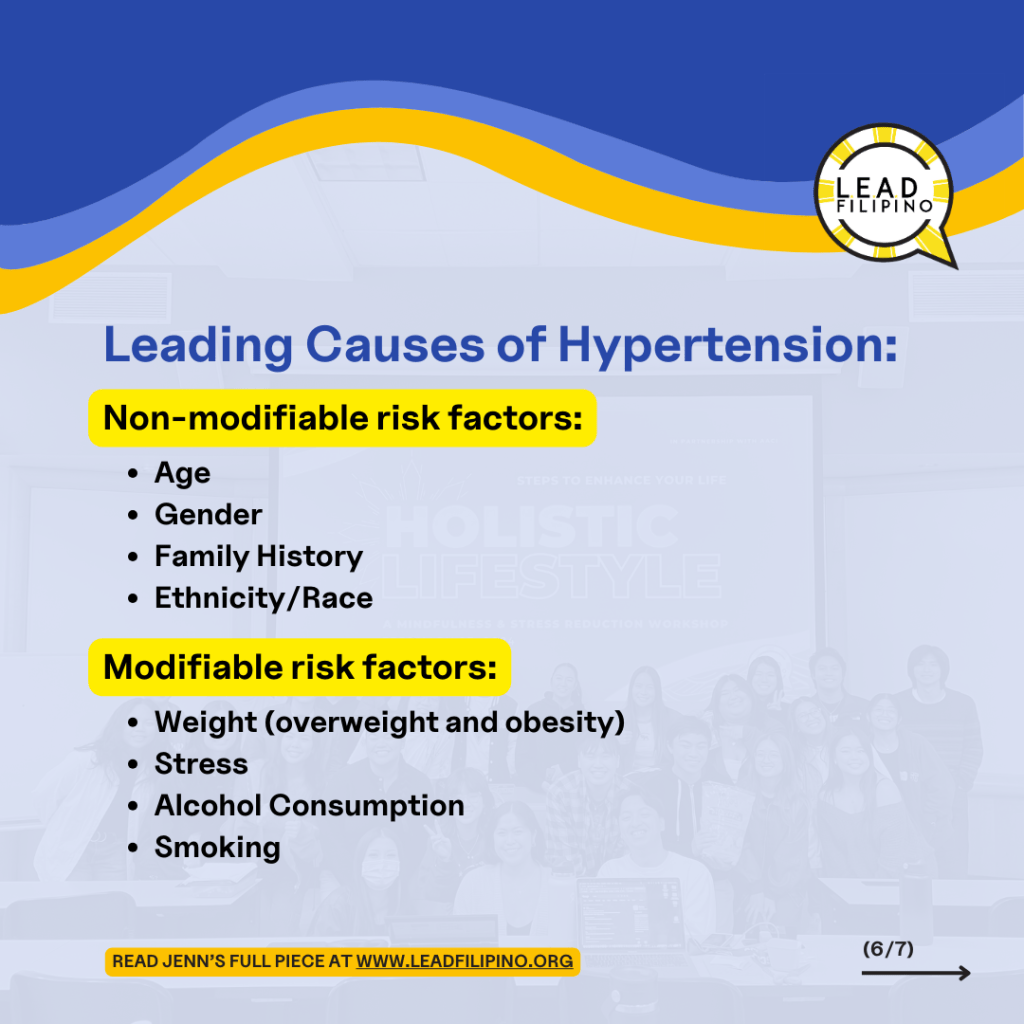
Blood pressure is the measurement of the force of your blood against the walls of the arteries as the heart pumps it around the body. When blood pressure is high for an extended period, it can damage the walls of blood vessels, causing them to develop tiny tears. What causes hypertension can be subdivided into two categories: non-modifiable risk factors and modifiable risk factors. Non-modifiable risk factors are causes that we are unable to control while modifiable risk factors are causes that we can change. Non-modifiable risk factors include age, gender, family history, and ethnicity/race. In contrast, modifiable risk factors include weight (overweight and obesity), stress, alcohol consumption, and smoking.
As a nursing student, I am met with many patients, of all ages, who unfortunately have preventable diseases such as hypertension and type 2 diabetes, both diseases that can lead to other cardiovascular diseases. As I learn about these different cardiovascular diseases, I am constantly wondering how I can relay this information back to the FilAm community. LEAD Filipino, as a community-based organization focused on health equity and disease prevention, hosts health education workshops to combat various types of diseases including, but not limited to, cardiovascular disease. We often table at local community events providing free blood pressure checks to community members and handing out free automatic blood pressure monitors. So far we have given over 50 blood pressure monitors and have given over a hundred blood pressure readings during our various community events. We have also passed out NARCAN, COVID-19 tests, and N95 masks during these events. It’s important to me to meet our community where they’re at and provide them with the resources and information they need to make informative decisions on their health. Our work is all about empowering our community members with the knowledge and tools to actively participate in their health.
Sometimes I meet other healthcare workers, mostly nurses, who opt to get their blood pressure checked and express having high blood pressure or being pre-diabetic themselves. In class, my fellow nursing classmates and I joked about how we’re here for a “good time not a long time” when we talk about our cultural food and the impact it has on our community’s cardiovascular health.
As healthcare professionals, we have the knowledge, background, and first-hand experience as to what can happen when individuals are not taking steps to control their hypertension. If untreated, often leads to other serious illnesses and diseases that can cause severe consequences such as heart attacks and stroke. As healthcare providers and healers, our community can often look to us as leaders who put their trust in our expertise and profession. During another community event, a gentleman expressed noticing his blood pressure was higher than what he was accustomed to as of recently, he was going to buy a blood pressure cuff, which can be costly, some costing as much as $100.
I saw a viral video on social media recently of a Filipino party where titas1 and titos2 took bets on each other’s blood pressure and glucose number results. I reflect on my own experiences at Filipino parties I’ve attended and am reminded of what we usually do; eat really good Filipino food, sing karaoke, watch a movie or sports game, and then eat again. Now that I am aware of different steps we can take to combat cardiovascular disease I started rethinking what we can do to support one another and positively contribute to our health and wellbeing. In comparison, I attended a birthday celebration of a non-Filipino friend. I was surprised that the main dish at this celebration was salad, I could not remember a time when salad was even at a Filipino birthday celebration. I think of steps I could take at Filipino parties, for example, after a hearty lunch or dinner with family, inviting my cousins to take a walk around the neighborhood, or putting on a game that encourages movement like a dance Dance Revolution video before singing our hearts out on karaoke. Or even bringing a side dish of veggies or salad to contribute to the party’s feast.
I encourage everyone to reflect on these questions: What are lifestyle modifications you’ve made to prevent high blood pressure or maintain your blood pressure? What are steps you can take to support your loved ones’ cardiovascular health?
Within our Health Equity team, we are committed to preventing cardiovascular disease. We do blood pressure checks and provide health-related resources at our tabling events. We consistently provide workshops on lifestyle modifications to empower our community to prevent diseases. Most recently, executing a cardiovascular health education workshop and have plans for more opportunities to stay active and educate the community on diseases that impact our communities.
References:
American Heart Association. (n.d.). What is high blood pressure? Retrieved from
https://www.heart.org/en/health-topics/high-blood-pressure/the-facts-about-high-blood-
pressure/what-is-high-blood-pressure
Ma, G.X., Lee, M., Bhimla, A. et al. Risk Assessment and Prevention of Hypertension in
Filipino Americans. J Community Health 42, 797–805 (2017).
https://doi.org/10.1007/s10900-017-0320-0
Sales, C., Lin, B., & Palaniappan, L. (2020). PH Data Brief [PDF document]. Stanford Medicine.
Retrieved from https://med.stanford.edu/content/dam/sm/care/PH-Data-Brief.pdf
Santa Clara County Public Health Department. (2017). Asian and Pacific Islander Health
Assessment [PDF document]. Retrieved from
https://publichealth.sccgov.org/sites/g/files/exjcpb916/files/aha-report.pdf
Sloot4Hugs [@sloot4hugs]. (n.d.). [Partying in your 60s] [TikTok video]. TikTok.
https://www.tiktok.com/@sloot4hugs/video/7338201502575643950?
is_from_webapp=1&sender_device=pc&web_id=7307329259106141739
